What the Ocean Does to Your Head After a Few Days
Spoiler: it goes a lot deeper than "I feel relaxed". And once you've felt it, you'll understand why people keep coming back. If you've spent time on the Moroccan coast, you've probably felt a version of it yourself. That quiet shift that starts around day two or three. You felt it but couldn't quite explain it. Here's what's actually happening.
By day three, something changes.
Not dramatically. No single moment you could point to. But somewhere between the morning session and the evening tagine, the mental noise that followed you here — the emails, the low hum of a life running at full speed, the background anxiety so familiar you stopped noticing it — starts to thin out.
You paddle out and you're just paddling out. Nothing else.
Most guests mention it at some point during the week. Not always in those words. Sometimes it's "I'm sleeping like a baby" — funny, because the call to prayer at six in the morning wakes everyone up. Sometimes it's "I haven't thought about work or my problems in hours." Or just "my body is completely wrecked but somehow I feel incredible." They came for the surf in Morocco. The mental reset wasn't on the itinerary. It showed up anyway.
Here's what's actually going on.
Surfing puts your brain somewhere it almost never gets to go
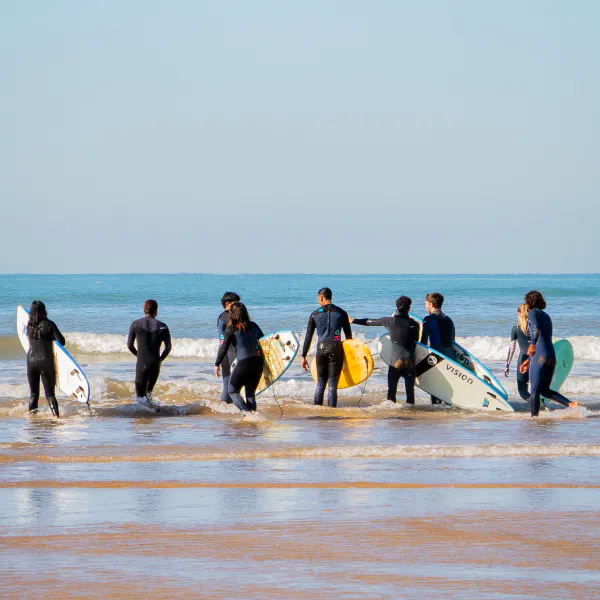
Nobody mentions this before a first surf trip to Morocco, but the ocean doesn't allow multitasking.
When a set is coming, you're present. Completely. Not because you decided to practise mindfulness — because a wave is arriving and it needs your full attention right now, or you end up underwater. The stakes are just high enough to make distraction impossible.
For people who spend most of their days splitting attention across twenty things at once, this is disorienting at first. Then, usually by the second or third session, quietly extraordinary.
Psychologists call it "flow" — total absorption in a task where skill level and difficulty are closely matched. Research consistently links flow states to reduced anxiety, lower cortisol, better sleep and improved mood. Surfing produces it almost automatically, especially when you're learning. The neurological afterglow builds across a week of daily sessions in a way that occasional weekend surfing simply can't replicate.
Most people haven't been in this state — genuinely, fully — in years. Some never have. The combination of physical demand, natural environment and real-time problem solving is something the modern world almost never provides. The Moroccan Atlantic coast, with its consistent swell and long open waves, gives you enough of it, often enough, to actually feel the shift accumulating.
What Morocco does that nowhere else quite manages
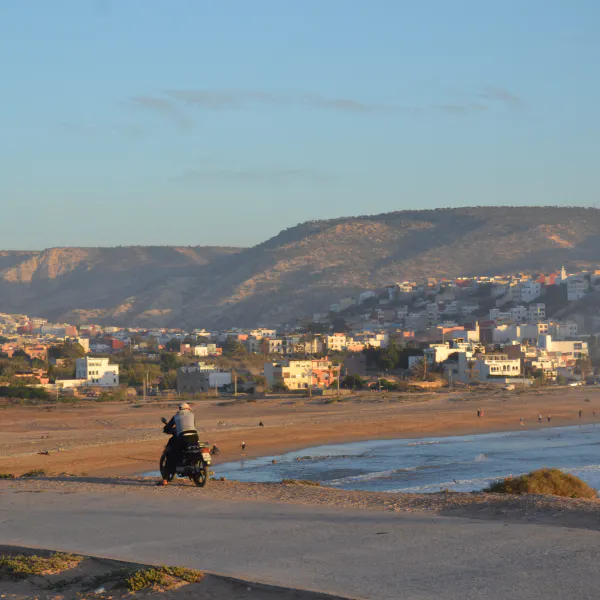
Morocco tells your brain, without a word, that the usual rules don't apply here. The colours, the call to prayer, the souk on a Wednesday morning — it's far enough from ordinary life to feel like a genuine break, not a rebranded version of the same routine somewhere warmer.
But it's more than visual contrast. The people carry something hard to name and impossible to fake. The kindness isn't customer service. The smiles in the street are just smiles. The unhurried pace of interactions that have no agenda beyond the interaction itself. Spend a few days inside this and something softens. You stop bracing for the transaction. The Moroccan way of life turns out to be contagious, and it works faster than you'd expect.
The stretch of Atlantic coast between Aourir and Taghazout amplifies all of it. Consistent surf, warm water, long sunny days, small villages that haven't been swallowed by tourism yet, and a landscape — the cliffs above Aourir going orange late in the afternoon, the colour of the sea on a clean morning — that quiets the mind without asking anything of you.
You feel it most strongly in Aourir itself. Still genuinely local, still running on its own rhythm, life going on around you without performing itself for visitors.
Ohana sits at the centre of this — and being a family-run surf camp based in Aourir isn't incidental. The team lives here, knows the neighbours, shops at the same market. That rootedness carries into the camp. Guests don't feel like they're passing through a surf tourism machine. They feel like they've been let into something real.
Most guests have never experienced this particular combination at once — the ocean, the culture, the pace, the people, the physical beauty of the place. Separately, any one of these things is good for the head. Together, in the same week, they produce something genuinely hard to find anywhere else in the world.
Why adding yoga or pilates takes it even further
Guests who combine surfing with yoga in Morocco or pilates at Ohana tend to notice the mental shift earlier and more completely — and the reason is physiological, not coincidental.
Yoga works directly on the nervous system regulation that surfing starts. Where surfing forces presence, yoga builds the capacity for it. Breathwork, slow deliberate movement, the quality of attention required in a held pose — all of these reinforce the parasympathetic state the ocean begins to establish. They're not two separate activities on a timetable. They genuinely amplify each other.
Pilates adds a different layer — precision, controlled movement, deep body awareness. Guests who do pilates sessions start feeling their weight shift through a surf turn rather than just executing it. The physical attention built on the mat carries directly into the water, and into how they feel the rest of the day.
The full combination — morning surf, evening yoga or pilates, fresh Moroccan food, proper sleep in a place that goes quiet at night — produces a week most people describe as one of the most genuinely restorative of their lives. Not passive restorative. Something earned. Something that lasts longer than the tan.
Why people keep coming back — the honest answer
Once you've felt this state, properly felt it, it's hard to forget.
Not because it's euphoric. It's quieter than that. More like remembering what it feels like to be okay — to not be bracing, to go to sleep without the low hum of everything unfinished and everything still to do.
The ocean has no interest in any of that. It just keeps doing what it does — set after set, tide after tide — and somewhere in the process of adapting to it, inside a culture that moves with a different kind of ease, something in your head gets quietly sorted out.
People come back to the Moroccan coast because they want to feel it again. Not because they're running from something. Because they found something here they didn't know they were looking for — and it turns out the world is easier to deal with from that place.
That's what makes it addictive. There are worse things to be addicted to.
Ohana Surf Morocco runs surf and yoga retreats and surf and pilates packages year-round in Aourir, on the Atlantic coast of Morocco — for all levels, from first-timers to people who already know exactly why they keep coming back. See what's available →